
Tirzepatide and GLP-1R: What a 2026 Simulation Study Reports

A new computational study has examined how tirzepatide, semaglutide and native GLP-1 interact with the GLP-1 receptor in its signalling complex. The work does not test a product in people. It uses Gaussian-accelerated molecular dynamics and related calculations to explore receptor shape, ligand binding and communication with the intracellular Gs protein.
Contents
What did the tirzepatide receptor study examine?
The paper analysed three representative agonists bound to the GLP-1 receptor and the Gs protein complex in a membrane environment. The authors combined molecular docking, Gaussian-accelerated molecular dynamics, molecular-mechanics Poisson-Boltzmann surface-area calculations and conformational analysis. These are computational methods. They can help researchers form mechanistic hypotheses, but they do not replace biochemical measurements, animal studies or controlled clinical research.
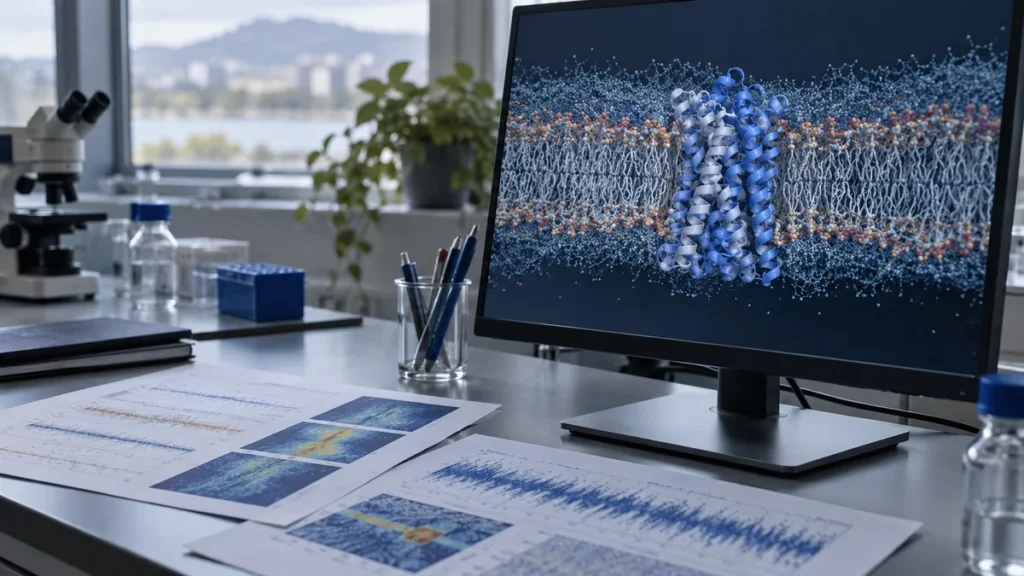
The central question was how ligand binding changes the receptor complex over time. The analysis considered the extracellular domain, the transmembrane domain and the interface where the receptor communicates with Gs. This matters because a receptor is not a rigid lock. Its shape fluctuates, and those movements influence how a bound molecule is transmitted into intracellular signalling.
What did the simulations report about tirzepatide?
The authors report that all three ligands stabilised the overall receptor complex, while producing different conformational patterns. In their simulations, tirzepatide showed distinct shifts compared with native GLP-1 and semaglutide. The paper also reports greater structural compactness for the tirzepatide-bound complex and a more negative calculated binding free energy under the study conditions.
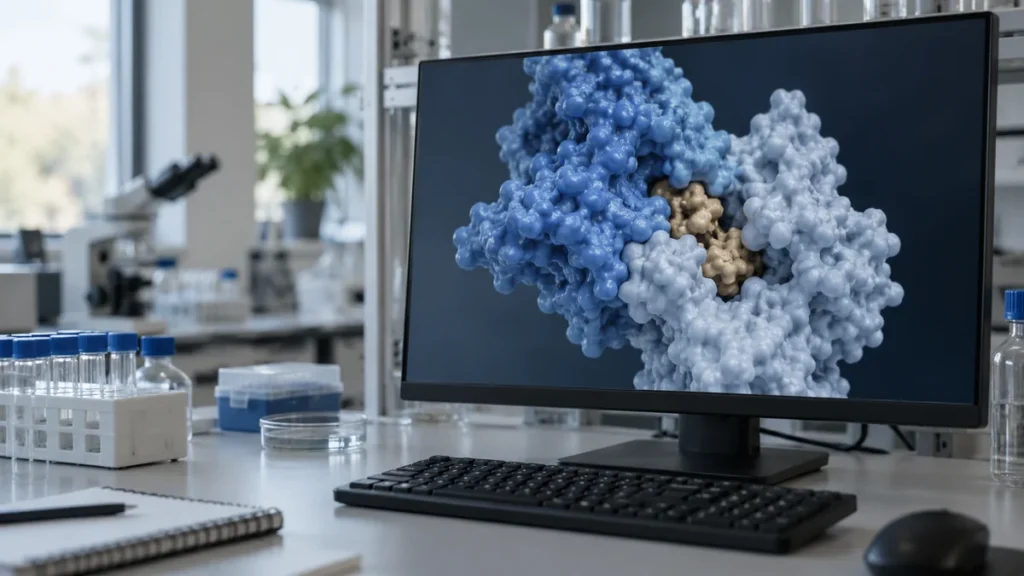
Those findings describe the behaviour of a modelled system, not a clinical outcome. A calculated free-energy difference is dependent on the model, sampling, force field and analysis choices. It should therefore be read as evidence about a computationally estimated interaction, rather than as a direct measure of efficacy, safety or suitability for any person.
Why does the GLP-1R-Gs interface matter?
The study highlights long-range communication between the receptor’s extracellular and transmembrane regions and the intracellular Gs protein. It also describes interactions involving the membrane environment and a region identified by the authors as the Zp interface. In the simulations, these contacts helped stabilise an active transmembrane conformation.
This type of result can guide follow-up work. Researchers may use it to compare structural hypotheses, design mutations, or decide which receptor states deserve experimental investigation. It cannot establish that one compound will produce a particular physiological response. The article itself remains a molecular modelling study, and its conclusions should stay within that evidence level.

What are the limits of a molecular dynamics result?
Computational studies simplify biology. The model cannot reproduce every protein, lipid, water molecule, cell type and regulatory process found in a living system. Simulation length and starting structures also affect the conformations that are observed. Agreement between several computational methods can strengthen an interpretation, but it does not turn a simulation into a clinical trial.
For readers comparing research papers, the useful distinction is between a structural mechanism and a demonstrated effect. This paper offers a structural mechanism for further testing: different ligands may stabilise receptor states in different ways. It does not provide dosing guidance, treatment advice or evidence about Peptra Labs products. Tirzepatide is an authorised medicine only in its authorised pharmaceutical products and indications. A research reagent is not that medicine.
Related on Peptra Labs
For background, see the tirzepatide research guide and the tirzepatide catalogue page. The analytical methods overview explains why computational evidence and laboratory measurements answer different questions.
References
- Interactions of Glucagon-Like Peptide-1 Receptor Agonists With GLP-1R-Gs Complex: Insights From Gaussian-Accelerated Molecular Dynamics. Proteins. 2026. PubMed. DOI: 10.1002/prot.70186.
The products referenced on this site are supplied for laboratory research use only. They are not medicines and are not intended for human or veterinary use. This article summarises published research for informational purposes and is not medical advice. Statements about third-party studies belong to their authors.
