
Could a second intervention that raises energy expenditure add to the body-weight effect of Tirzepatide? A new mouse study tested that idea using intermittent cold exposure. The answer in this experiment was no: the combination did not produce additional weight loss beyond tirzepatide alone.
That negative result is the useful result. Combination experiments are often framed around what might add together. This study was designed to ask whether reduced energy intake and cold-induced thermogenesis would do so in obese mice, and it found separate effects without an additive weight-loss outcome.
The four-group design
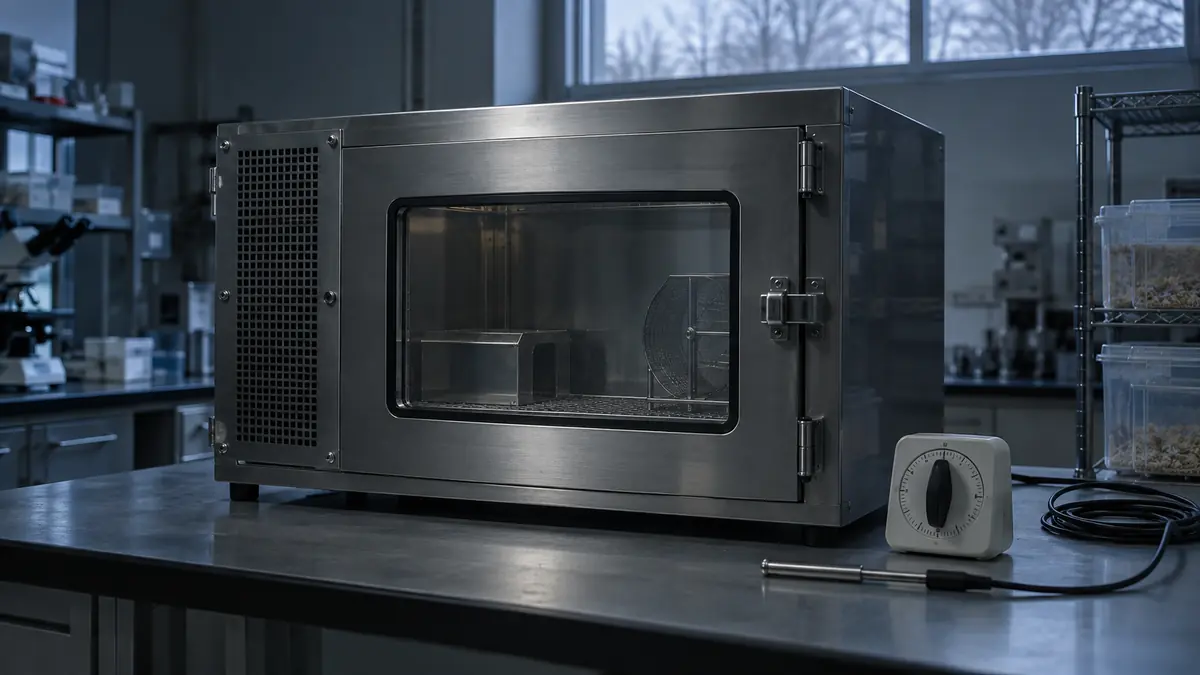
Researchers fed male and female C57BL/6J mice a high-fat diet for eight weeks. For the following three weeks, mice received tirzepatide or vehicle and were either exposed or not exposed to intermittent cold. The cold protocol was 4 degrees Celsius for one hour a day, five days a week.
The authors measured body weight, body composition, food intake, energy expenditure and glucose homeostasis. This created four conditions: vehicle without cold, vehicle with cold, tirzepatide without cold, and tirzepatide with cold. A factorial design like this is needed to distinguish the effect of each intervention from the effect of the combination.
What changed, and what did not
Tirzepatide reduced body weight, food intake and adiposity in both sexes. Intermittent cold exposure acutely increased energy expenditure and improved measures of glucose homeostasis without changing body weight. The combined condition did not add to the weight loss seen with tirzepatide.
The word “not” carries the central finding. It does not mean that cold exposure had no measured effect, nor that tirzepatide had no effect in this model. It means the authors did not observe the expected extra reduction in body weight when both interventions were used together under this protocol.
The study also does not establish a universal rule for thermogenesis. It tested one mouse strain, a high-fat-diet model, a specific cold schedule and a three-week treatment period. A different temperature, duration, diet, species or endpoint could yield a different pattern. Those possibilities are research questions, not conclusions from this experiment.
Why an additive effect was plausible
The premise was not arbitrary. Tirzepatide lowered food intake in the current study, whereas cold exposure acutely raised energy expenditure. Earlier mouse work reported that tirzepatide induced a thermogenic-like amino-acid signature in brown adipose tissue. That prior finding gave researchers a reason to examine how a cold stimulus and tirzepatide might interact.
But a plausible mechanism is not a guarantee of a larger combined outcome. Biological systems can compensate. Energy use can rise only transiently, intake can change, tissues can adapt, and effects on different measures can fail to combine into a larger body-weight difference. The new study is valuable precisely because it tested the assumption rather than presenting it as established.
Reading a preclinical result at its scale
All subjects were mice. The protocol used 10 nmol/kg tirzepatide and a controlled cold exposure. These details define an animal experiment; they are not directions for human use. The authors report changes in an experimental model, not advice for people or a clinical treatment strategy.
Peptra Labs lists Tirzepatide as laboratory reference material. The European research buyer guide, laboratory protocol for peptide storage, Research Use Only boundary and research peptides risk profile place that catalogue in a research-only setting. The findings in this paper do not create a therapeutic claim about a listed product.
What the study contributes
The experiment separates two observations that can easily be blurred. Intermittent cold raised energy expenditure and improved glucose-homeostasis measures independently of body-weight change. Tirzepatide reduced body weight, food intake and adiposity. Yet their combination was not additive for weight loss over three weeks.
That is a clean result for future metabolic experiments. Rather than assuming that interventions aimed at different parts of energy balance must sum, researchers can measure the interaction directly. Replication with planned mechanistic endpoints, longer follow-up and other models would show whether the lack of additivity is specific to this design or reflects a broader constraint.
The study therefore narrows a hypothesis. It does not settle human physiology, prescribe an environmental exposure, or determine how any product should be used. In preclinical research, a carefully documented null interaction can be as informative as a dramatic positive signal.
What a follow-up experiment could test
A follow-up study could vary one feature at a time: the cold schedule, the duration of treatment, the interval between exposure and measurement, or the diet-induced-obesity model. It could also pre-specify tissue and metabolic endpoints that distinguish a transient increase in energy expenditure from a sustained change in energy balance. Those experiments would not revise the current result; they would test where its boundary lies.
The present design is especially useful because it contains both single-intervention arms. Without them, a combined group could not show whether a change arose from cold, tirzepatide, or their interaction. The absence of additivity is therefore not an empty result. It tells later experiments that combining two plausible mechanisms is not itself evidence that their effects will sum.
References
- Bellucci A, et al. Increased energy expenditure through intermittent cold exposure does not enhance tirzepatide induced weight-loss in obese mice. American Journal of Physiology-Regulatory, Integrative and Comparative Physiology, 10 September 2026. PubMed
- Samms RJ, et al. Tirzepatide induces a thermogenic-like amino acid signature in brown adipose tissue. Molecular Metabolism, 2022. PubMed
The products referenced on this site are supplied for laboratory research use only. They are not medicines and are not intended for human or veterinary use. This article summarises published research for informational purposes and is not medical advice. Statements about third-party studies belong to their authors.