Retatrutide
An investigational triple-agonist peptide targeting GLP-1, GIP, and glucagon receptors, demonstrating body-weight change of up to 24.2% in phase 2 trials alongside improvements in cardiometabolic parameters and hepatic steatosis. All presented information is based on scientific publications which can be found at the end of product description below.
Batch-level quality proof
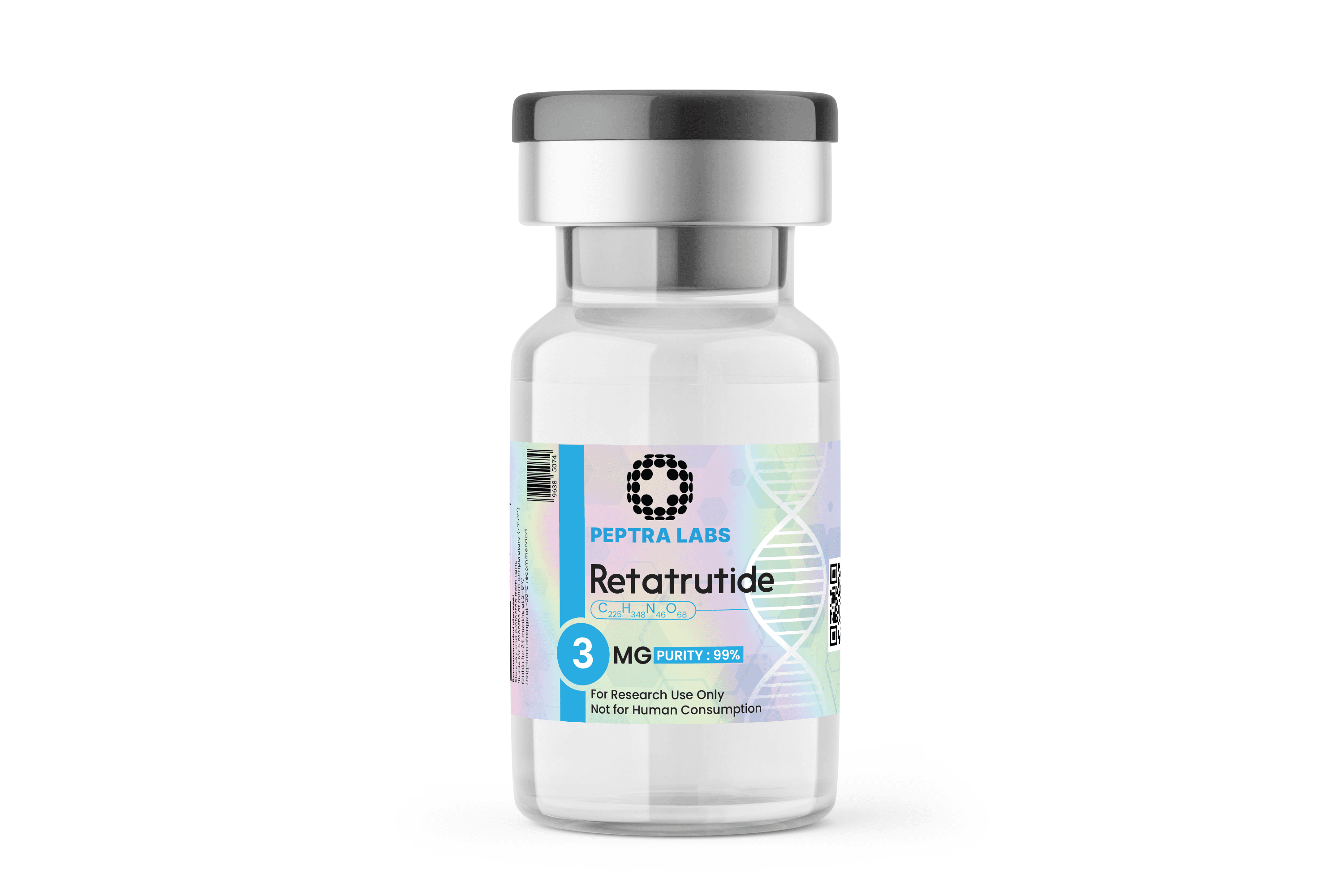
Every research peptide is supplied as a sealed, clearly labelled vial. Batch-level CoA information and purity testing records are available online where applicable, not shipped as research paperwork in the parcel.
Clear label, lot traceability, protective packaging.
Listed report available for batch GY035. Purity shown: 99.7%.
Not for human or veterinary use, no protocol or dosing advice.
Retatrutide CoA authority cluster
Use these pages to connect retatrutide product data, batch-level CoA information, RUO policy, and the GLP-1/GIP/glucagon research guide.
Product specifications
Description
All presented information is based on scientific publications which can be found at the end of product description below.
Retatrutide (LY3437943) is a synthetic triple agonist of GLP-1, GIP, and glucagon receptors developed by Eli Lilly, enabling simultaneous modulation of appetite, glycemic control, energy expenditure, and lipid metabolism. Research Highlights 1. Obesity — Phase 2 trials showed 22.8-24.2% body-weight change at 8-12mg doses over 48 weeks, comparable to bariatric surgery. Liver fat reduced by up to 82.4%.
2. Type 2 Diabetes — HbA1c reduction of 2.16% at 12mg (vs 0.43% placebo). Body-weight change of 16.94% with continued trend beyond 36 weeks.
3. Liver Protection — 89-93% of patients achieved hepatic fat normalization at 48 weeks, positioning retatrutide as promising for metabolic liver disease. References available upon request. The product is intended for scientific research and development purposes only. Chemical substances shall not be used as a drug, medicine, active substance, medical aid, cosmetic product, a substance for production of a cosmetic product neither for human consumption that is any food or food supplement or otherwise similarly used on humans or animals. Intended only for in-vitro research, such as Receptor-ligand binding studies, Enzyme activity assays, Cell proliferation assays, Cell signaling assays, Epitope mapping, etc.
Research Use Only: The product is intended for scientific research and development purposes only. Chemical substances shall not be used as a drug, medicine, active substance, medical aid, cosmetic product, a substance for production of a cosmetic product neither for human consumption that is any food or food supplement or otherwise similarly used on humans or animals. Intended only for in-vitro research, such as Receptor-ligand binding studies, Enzyme activity assays, Cell proliferation assays, Cell signaling assays, Epitope mapping, etc.
🇪🇺 EU & UK shipping • Free over €300 • estimated at checkout
Frequently asked questions
- Retatrutide is a synthetic 39-amino-acid peptide engineered as a triple agonist of GLP-1, GIP, and glucagon receptors. Molecular weight ≈ 4731 Da. It is one of the most studied next-generation GLP-1 class molecules in current clinical research (under the trade name LY3437943 in active Eli Lilly trials).
- Batch-level CoA information is available where applicable and focuses on purity testing, lot details, and synthesis information.
- Store lyophilised at -20 °C in a sealed, desiccant-protected vial. After laboratory preparation, retatrutide is best aliquoted and stored frozen for stability because large peptides are particularly sensitive to freeze-thaw and surface adsorption.
- Retatrutide appears in clinical-trial literature for obesity and metabolic disease (Phase III as of 2025-2026). Research-grade material is used in preclinical pharmacology, receptor binding studies, and metabolic models. Peptra Labs supplies it only as laboratory research material.
- Retatrutide is discussed in investigational clinical-trial literature. Peptra Labs supplies it strictly for laboratory research, not for human or veterinary use.